PICTURE BOOKS
The Bomb and the General by Umberto Eco, Grades 4-8
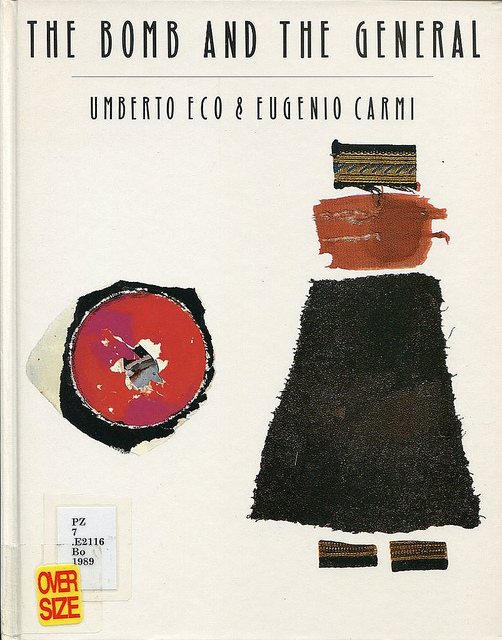 Description: The short picture book book briefly describes the structure of the atom, and in greater detail describes the use of nuclear weaponry in vivid language.
Significance: The book allows students to discuss the controversial uses of knowledge that were developed from atomic theory. The source could be used to connect science developments to ethical issues and encourage a greater interest in science. This book would not be appropriate for very young students since they may not understand the emotional statements and the controversies associated with the topic.
Q Is for Quark: A Science Alphabet Book by David Shwartz and Kim Doner, Grades 6-9, Lexile 940
http://childrenspicturebooks.info/articles/finding_science_treasure.htm
 Description: This book is an alphabet book that covers several atom related subjects very well. The covers the atom, the element, H2O, and Quarks. The book has very good information that is stated in very simple English and supported with excellent pictures.
Significance: The topics in the book could be used as short readings for students that are having difficulty comprehending traditional textbooks.
YOUNG READER BOOKS
Stories about the Atomic Bomb by Jennifer Fandel, Grade 6+
 Description: This book covers the issues leading up to the use of the atomic bomb. The emphasizes the life of Robert Oppenheimer and the events that encouraged the development of the bomb. Not only does the book make connections between the type of work scientists do, but also makes connections between politics and technology.
Significance: The content of the book encourages interest in the history of science and the persuasive style may appeal to young boys. The book also is appealing to young boys due to a very graphically elaborate cover.
What Is Atomic Theory? (Shaping Modern Science) by Adam McLean, Grade7+, Lexile 1230
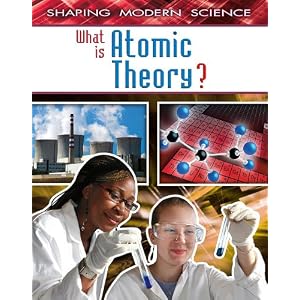
Description: This book does a very good job of providing a more detailed look at the historical development of atomic theory. The book discusses Dalton's contributions and the structural components of the most simple atomic models.
Significance: The book provides an excellent review for mature science students and a great introduction to middle schools. Unlike many books, the text provides a fairly decent description of the components of the atom.
A Really Short History of Nearly Everything by Bill Bryson, Grades 4+
Description: The book has a very odd collection of stories, but the stories of the origins of the universe cover several interesting ideas about why certain elements are more plentiful than other elements. Another interesting aspect of the book is that the sources are not very well cited, if cited at all.
Significance: Due to the collection of stories, students could be assigned to take an odd story from the book and to prove or disprove the statement. The illustrations are very helpful with the content and introduce a new dimension of learning about the atom.
Significance: Due to the collection of stories, students could be assigned to take an odd story from the book and to prove or disprove the statement. The illustrations are very helpful with the content and introduce a new dimension of learning about the atom.
ADULT BOOKS
The Making of the Atomic Bomb: 25th Anniversary Edition, by Richard Rhodes, Grade 10+
 Description: This novel emphasizes the development of the atomic bomb in a more sophisticated way. More advanced students would enjoy the detail and the description of how science is performed in a fashion that is different than what is typically discussed in high school sciences.
WEBSITES
Atoms, Grade 7+
Description: This website provides an excellent summary of the component makeup of the atom. This website is a great alternative to a paper textbook.
Significance: The tutorial provides bolded key words and graphical representations of the text. In addition to the content tools, the website also provides quizzes that provide immediate answers to each question.
The Power of Ten, Grade 5+
Description: This website's application shows the size of different objects and allows for zooming to smaller and smaller objects.
Significance: Although many textbooks write about the size of atoms and other objects, they typically do a poor job of illustrating size. This website allows for very direct observations of different sized objects, including objects that students may confuse with being atomic sized like structures within the cell.
A Brief History of Atomic Theory Development, Grade 7+
Link: http://web.neo.edu/rjones/Pages/1014new/Lecture/chemistry/chapter_8/pages/history_of_atom.html
Description: This website provides an excellent overview of the scientists involved in atomic theory development. The website directly covers national standards and majority of different state standards without adding in very much periferal information.
Significance: Chemistry textbooks tend to be either overly detailed or completely lacking certain topics. This website provides an overview of the most important atomic theory events with only a small amount of reading.
Historical Model of the Atom, Grade 10+
Description: This website is somewhat unique because it presents four additional models of the atom that were released since the development of the Bohr Model and Quantum Mechanical Model. Unlike the other historical websites, this website emphasizes the utility of models and how scientists use models.
Significance: This website is somewhat different than most other historical websites due to sections that discuss models and the philosophy of science. The website does an excellent job at demonstrating how models have utility that is being changed and improved upon based upon the need of the scientist.
SIMULATIONS, VIDEOS, AND MULTIMEDIA
General Atom Video, Grade 9+
Description: This video provides similar information as the websites above but in a very visually appealing way. The information is best understood with a small amount of information about the atom due to the references to some atomic principles.
Significance: This video would be great supplement or a precursor for a more complicated text.
Atom Description, Grade 11+ or Teacher
Description: This website provides the most detailed explanation of atomic theory which includes visuals of the quantum mechanical models. Rarely is the quantum mechanical models represented as a shape, but this website provides a very nice, yet simple model that represents all the key parts of that model.
Significance: The material was written by a physicist and is more technical and more numerical than the other websites. This may be more beneficial for a teacher as a great way to summarize notes or to prepare for difficult student questions.
Atom Song, Grade 7+
Description: This is an attention grabbing music video about the atom that is set to a modified Maroon 5 song. This is not the only song available that uses modern music but this is one of the most well done altered songs.
Significance: Students do not always take an interest in historical science topics but this video may grab the students attention as they listen to how the author modified the lyrics of the song. In addition to being visual, the words to the song are displayed in the video so that the song can be read.
Build Atoms Yourself
Link: http://www.classzone.com/books/earth_science/terc/content/investigations/es0501/es0501page04.cfm
Description: This website provides a small tutorial about atomic structure and then provides an application where you can create your own atom. As you develop your atom, the application tells you what atom you have created and modifications that needed to make the structure more theoretically correct.
Significance: This application allows students to use their knowledge to create an atom and it encourages the student to revise their models based upon the generated suggestions.
NEWS ARTICLES
Science Articles, Grades 9+
Description: The two above websites provide current news articles. The articles range in difficulty from very basic to fairly complicated. The value of these websites lies in the information about current research and controversies in science. These websites also allow for students to select articles that may interest them.
Significance: These websites provide current issues in science so that students realize that science is a continuing and evolving process with many unknown answers to even old topics. The websites also provide insight into the ability of scientists to explore beyond theory into more application based topics.

What I like most about this text set is the opportunities you mention to discuss controversy and for students to have their own views. Too often science is thought of as having always been set in stone, but you mention the moral and political ramifications of nuclear weapons, as well as differing atomic models depending on scientists' needs. The Power of Ten demo would also be an opportunity for cross-curricular connections to logarithms in math.
ReplyDeleteI really like how diverse your text set is. It can accomodate a variety of reading ages and reading levels. I also enjoy how you describe the significance of each text. The build atoms yourself interactive site seems like it would be extremely useful to a variety of chemistry classes. I would see it benefiting both honors and regular chemistry classes.
ReplyDeleteI really like that you included children's books in your text set collection. Since my area is 7-12. I don't often think to include reading for younger students. I'm not sure how I feel about a children's book about bombs, but I suppose young children are naturally interested in anything that makes noise or messes, so it would probably be popular reading in my daughter's first grade class. Besides, it is never to early to start introducing scientific concepts, even if they can be used to create mass destruction.
ReplyDeleteThis text set contains great material for learning about the atom, its background, and historical significance. This text set ties history and science together in a very natural way. Plus, it gives students a tangible (in the sense that they have heard about the atomic bomb) example and sparks interest in the topic of the atom.
ReplyDelete